
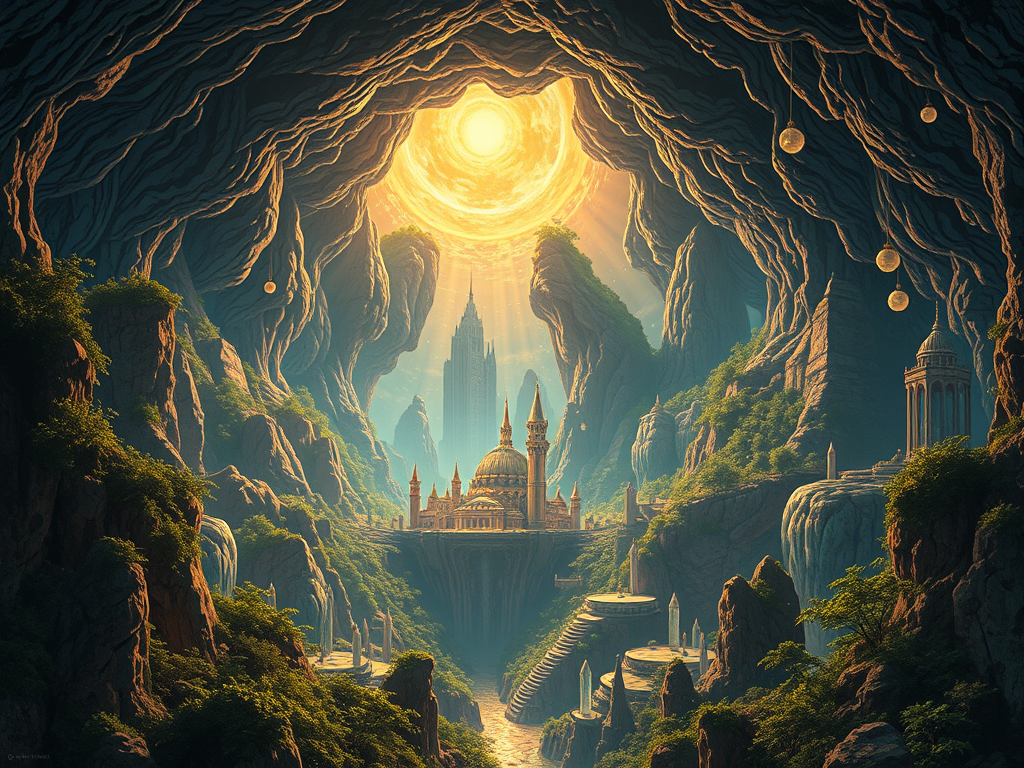

The idea of a secret world inside Earth—often called the Hollow Earth or Inner Earth—has captivated imaginations for centuries. It’s a blend of ancient myths, speculative science, occult traditions, and modern conspiracy lore. The children’s book George and the Secret World Inside Earth: A 10-Year-Old Boy’s Adventure to Save the Hidden Crystal Sun taps into this timeless fascination, sending young George and his loyal dog Max through a magical glowing stone gateway to a vibrant subterranean realm of giant jungles, shimmering crystal cities, and a life-giving Hidden Crystal Sun that’s slowly fading. George’s quest to save this inner paradise, driven by his courage and deep family love, echoes the wonder and heroism found in many classic tales of inner Earth.
But where do these stories really come from? Let’s explore the rich history behind the concept of hidden worlds beneath our feet.
Ancient Roots in Myth and Legend
Stories of subterranean realms date back to antiquity, long before modern science mapped Earth’s interior. Many cultures imagined underground domains as places of the afterlife, hidden knowledge, or lost civilizations:
- In Greek mythology, the underworld (Hades) featured vast caverns and realms below the surface.
- Norse lore described Svartálfaheimr, a shadowy underground world of beings.
- Hindu traditions spoke of Patala, a multi-layered underworld inhabited by serpentine beings (Nagas) and advanced societies.
- Tibetan Buddhist texts reference Shambhala (or Shamballa), a mystical kingdom of enlightenment often depicted as hidden in a remote valley or, in some interpretations, within the Earth itself—home to wise beings guarding ancient wisdom.
These early myths portrayed the inner Earth as spiritual or otherworldly, not necessarily a literal hollow planet.
The Rise of the Hollow Earth Theory
The concept evolved into a more structured “scientific” idea in the 17th–19th centuries. English astronomer Edmond Halley (of comet fame) proposed in 1692 that Earth consisted of nested concentric shells with spaces between them, possibly inhabited and lit by an inner glow, to explain magnetic anomalies.
In the 19th century, American explorer John Cleves Symmes popularized the notion of polar openings—vast holes at the North and South Poles leading to a habitable inner world. He campaigned for expeditions and inspired works of fiction such as Symzonia (1820), an early hollow-Earth novel.
Jules Verne’s Journey to the Center of the Earth (1864) brought the idea to mainstream audiences with its adventure into volcanic passages and prehistoric inner worlds.
Occult writers added mystical layers. In the late 19th century, French esotericist Alexandre Saint-Yves d’Alveydre described Agartha (or Agarttha), a vast underground kingdom in Central Asia (sometimes linked to the Himalayas) ruled by enlightened masters with advanced knowledge. This blended with Shambhala legends and influenced Theosophy and later New Age thought. Agartha became synonymous with a utopian inner Earth civilization, often portrayed as spiritually superior to surface humanity.
Admiral Byrd and the Modern Conspiracy Angle
One of the most enduring modern chapters involves Rear Admiral Richard E. Byrd, the famous polar explorer. Byrd led multiple expeditions to Antarctica, including the massive Operation Highjump (1946–1947), a U.S. Navy mission with ships, planes, and thousands of personnel—officially for mapping, training, and scientific study in the post-WWII era.
Conspiracy theories claim that Byrd discovered far more. A purported “secret diary” (first popularized in the 1950s–1960s by writers like Raymond Bernard in The Hollow Earth) alleges that during a 1947 flight (often tied to Highjump), Byrd flew into a polar opening, entered the inner Earth, and encountered an advanced civilization—sometimes described as tall, fair-haired beings in a lush, green land with cities and flying craft. They allegedly warned him about humanity’s dangers (like nuclear weapons) and sent him back with a message of peace.
These accounts often mix elements: UFOs, Nazi connections (rumors of secret Antarctic bases), and hidden realms. However, the “diary” is widely regarded as a hoax. Byrd’s actual logs and interviews describe no such encounters, and inconsistencies (e.g., confusing North and South Pole details) abound. Official records show Highjump ended due to weather and logistics, not mysterious forces. Fact-checkers and historians dismiss the inner-Earth claims as later inventions that fueled books, videos, and online lore.
Family Adventure Press: The Publisher That Brings These Tales to Life
Published by Family Adventure Press, George and the Secret World Inside Earth (along with related titles like George and the Ice Giants of Inner Earth) is part of a charming, family-created series that blends backyard wonder with fantastical portals and mythical explorations. Family Adventure Press is a small, independent publisher run by a mom-son-grandma trio based in the U.S. Their mission is to spark curiosity, strengthen family bonds, and show that the greatest adventures start right outside your door. We are turning everyday elements (like a soccer ball or a hole in the ground) into gateways to extraordinary worlds.
We feature free downloadable adventures, bonus pages, printables, and blog posts on topics like healthy picnic snacks, the real roots of Bigfoot legends, and nature-grounded curiosity. They emphasize turning bedtime stories into “passports to other dimensions” while keeping content wholesome, accessible, and family-focused. Books are available in large print, paperback, and eBook formats (ideal for young or emerging readers) primarily through Amazon, where the publisher notes their collaborative, heartfelt approach: “Family Adventure Press is a mom-son-grandma trio bringing you backyard adventures where soccer balls open portals, holes turn into tunnels, and antique watch compasses point to hidden realms.”
This personal touch makes their stories feel like shared family treasures—perfect for parents, grandparents, and kids who love imaginative tales rooted in exploration and heart.
How It Ties Back to George’s Adventure
George and the Secret World Inside Earth draws from this tapestry of wonder without the darker conspiracy edges. Instead of polar entrances or ancient warnings, George’s story uses a magical glowing stone as the portal to a fantastical inner realm threatened by a dimming Crystal Sun. Blending adventure, family bonds, and environmental themes in a kid-friendly way. It’s a fresh take on the genre, reminiscent of Verne’s spirit of exploration but infused with modern family values and imagination.
These inner Earth stories persist because they tap into deep human curiosities: What lies beyond the known? Could paradise or wisdom hide just beneath us? From ancient myths of Agartha and Shambhala to speculative polar tales like Byrd’s, they reflect our hopes for hidden utopias and mysteries waiting to be discovered.
Whether pure fantasy like George’s glowing adventure or the debated legends of old, the secret world inside Earth remains one of the most enchanting “what if” ideas in human storytelling. Have you checked out Family Adventure Press’s other free resources or George’s sequels? They’re great for igniting that sense of wonder in young readers.
This page contains Amazon affiliate links for Family Adventure Press books. As an Amazon Associate, we earn from qualifying purchases at no extra cost to you.